


“How much does a dog haircut cost?” sounds like it should have a one-line answer. After enough years behind the clippers, I can tell you it does not — because a 15-pound Shih Tzu, a 35-pound doodle and a 70-pound poodle mix all need “a haircut” and none of them is the same appointment.
What does have a clear answer is what your dog costs, once we know two things: how much they weigh, and what condition the coat is in.
Our Essentials haircut prices are based primarily on weight, and the haircut includes the bath. A 16–25 pound dog is currently around $165, a 25–40 pound dog around $178, and a 41–60 pound dog around $190. Larger dogs move up from there by weight category.
These are current estimates, not a promise that every dog finishes at the same number. Coat condition, matting and additional services can change what the appointment requires. For a starting figure on your own dog, use our instant price estimator.
Dog haircut prices by weight
Here is the full Essentials haircut range, rounded to the nearest dollar so it works as a budgeting guide:

| Dog size | Weight | Estimated haircut price |
|---|---|---|
| Miniature | 0–15 lbs | About $153 |
| Small | 16–25 lbs | About $165 |
| Medium | 25–40 lbs | About $178 |
| Large | 41–60 lbs | About $190 |
| X Large | 61–70 lbs | About $203 |
| XX Large | 71–80 lbs | About $215 |
| Plus | 81–90 lbs | About $227 |
| X Plus | 91–100 lbs | About $240 |
| XX Plus | 101–110 lbs | About $252 |
| Major | 111–120 lbs | About $264 |
| X Major | 120–130 lbs | About $277 |
| XX Major | 131–140 lbs | About $289 |
So the listed range runs from approximately $153 for dogs in the 0–15 pound category to approximately $289 for dogs in the 131–140 pound category.
These are weight-based starting points, not breed prices. A 20-pound Shih Tzu and a 20-pound mixed breed sit on the same line even though their coats can require very different preparation.
What the haircut price includes
This is the question I would ask any groomer before comparing prices, because “haircut” is not a standardised word in this industry.

With our Essentials haircut service, the bath is included. The appointment covers washing, thorough rinsing, a full dry and brushing the coat out before the haircut itself begins.
That preparation is not a formality — it is what makes the haircut possible. Clipper blades and shears do not track evenly through damp, compressed or tangled hair. A coat that has been properly cleaned, dried all the way to the skin and combed through is the only reliable starting point for an even finish. Groomers who skip that step are the reason some haircuts look choppy two days later.
The haircut then covers the body trim, shaping and finishing work appropriate for the coat and the service selected.
So when you compare prices, make sure you are comparing the same thing. A price that includes the bath and dry is not the same product as a price that covers clipping alone.
The haircut North Texas dogs actually need
Most national grooming advice is written for a four-season climate. Ours is not one, and it changes what a sensible haircut looks like here.
Summer is the big one, and it is where the worst advice circulates. Once we are into a stretch of 100°F days, owners start asking for everything to come off — including on double-coated breeds. Shaving a Labrador, Golden Retriever, Husky or German Shepherd does not cool them down. That double coat insulates against heat as well as cold, and clipping it removes the dog’s sun protection while damaging how the coat regrows. What those dogs need in a Texas summer is a thorough deshed to strip the loose undercoat out so air can move, not a clipper. A good groomer here will tell you that rather than take the booking.
For single-coated dogs — poodles, doodles, Shih Tzus, Maltese, Yorkies — a shorter summer length is genuinely sensible, and most owners here run shorter in June than they do in January.
Paw and sanitary work matters more locally than people realise. Sandburs are widespread across North Texas lawns, greenbelts and unmown lots, and they lodge in the hair between the toes and around the sanitary area. Keeping those areas tidy through late summer and autumn saves a lot of limping and a lot of picking burrs out with tweezers.
Haircut frequency runs higher here. Dogs in this climate are outdoors more of the year — mild winters mean the yard and the trail stay in use in January — so coats collect more dust, pollen and debris. A single-coated dog on a “four to six weeks” schedule elsewhere often lands nearer four weeks here, particularly through spring pollen and late summer.
And there is the clay. Much of Collin and Denton county sits on blackland prairie soil, which turns to heavy, dark clay after rain and works deep into a long coat. It is not a pricing factor on its own, but it is a good reason not to let a long coat run too far between appointments.
Why the price rises with size
A larger dog has more coat to wash, considerably more coat to dry, and more surface area to trim. The appointment takes more time, more product and more physical work from the groomer.
That is why Essentials haircut pricing steps up by weight category. A 16–25 pound dog is currently about $165, while a 61–70 pound dog is about $203, and a dog in the 101–110 pound category is about $252.
Those gaps reflect something real. Drying a 100-pound double coat properly is not a slightly longer version of drying a 20-pound one.
But weight is only half the picture.
The coat is the other half
Two dogs can weigh exactly the same and need very different amounts of work.

A 25-pound dog with a short, maintained coat is a straightforward appointment. A 25-pound doodle with a dense curly coat is not. Long and curly coats have to be dried thoroughly and brushed through completely before cutting, because any tangle left underneath the surface will show up as an uneven line the moment the clippers pass over it.
This matters most with poodles, doodles, Shih Tzus, Maltese, Yorkies and other coats that keep growing rather than shedding out. Those coats hold onto shed hair instead of releasing it, which is why they need both regular professional grooming and consistent brushing between appointments.
So when someone asks what a 20-pound dog’s haircut costs, I can give them the weight category immediately — but I still want to know what kind of coat we are working with before I call it an estimate.
What about doodle haircuts?
Doodles come up more than any other breed in pricing conversations, and the honest answer is that there is no single “doodle coat.”
Some doodles carry loose waves that comb out easily. Others have tight, dense curls that can compress close to the skin within weeks. Two puppies from the same litter can grow entirely different coats, and a doodle’s coat often changes texture significantly between about eight months and two years old.
That is why I would not go looking for one universal Goldendoodle haircut price. Start with weight, then account for the coat.
A doodle in the 25–40 pound category has an Essentials haircut price of about $178, while a doodle in the 41–60 pound category is about $190. If you have one, the full breakdown is in our guide to Goldendoodle grooming costs in the Dallas-Fort Worth area.
How matting changes the appointment
Matting is not hair that looks a bit untidy. A mat forms when shed hair wraps around hair still anchored in the skin, and every bit of movement pulls it tighter until it compresses against the body.
At that point, forcing a comb or a blade through it is uncomfortable for the dog, and the safest option is often to remove the matted coat rather than try to save it.
This is why a haircut on a well-maintained dog and a haircut on a dog who has not been brushed in months are not the same service. Our Essentials pricing lists dematting separately, currently ranging from about $55 to $75 depending on the dog’s size.
That is not a charge for every small tangle. It applies where substantial matting creates additional work or changes how the groom has to be performed.
The best defence is a steel comb and five minutes, a few times a week. If the comb runs cleanly from the skin outward, the coat is genuinely brushed. If it catches, a brush has been skating over the top of a tangle.
A shorter haircut is not automatically a cheaper one
This surprises people. If you ask for the coat to be taken right down, shouldn’t that cost less?
Not really — because the price is not calculated on how much hair ends up on the floor.
The dog still has to be bathed, rinsed, dried and prepared. The groomer still works around the face, ears, feet, legs and sanitary areas, which is where the slow, careful work lives regardless of the body length. And a very overgrown coat can take more preparation before a short clip, not less.
What a shorter haircut genuinely does is make the weeks between appointments easier to manage. That is a good reason to choose one. Lower cost is not.
How often should your dog be clipped?
It depends on the coat type and the length you want to hold.
Dogs with continuously growing coats generally need a regular schedule because the hair has no natural stopping point. Poodles, doodles, Shih Tzus, Maltese, Yorkies and similar coats become progressively harder to maintain if appointments drift too far apart — and the further they drift, the more likely the next groom ends shorter than you wanted.
For most curly and long coats, four to six weeks is a sensible planning interval, with the shorter end of that being more realistic through our spring pollen season and late summer. Shorter body lengths can stretch further; longer, fuller styles need tighter spacing and more brushing at home.
There is also a practical argument. A dog who comes in on schedule arrives with a coat already in good condition, which keeps the appointment predictable in both length and price.
What can cost extra
The haircut price covers the Essentials haircut service. Some dogs need additional work: dematting, deshedding, gland expression, a paw-dicure, special handling or other specific services.
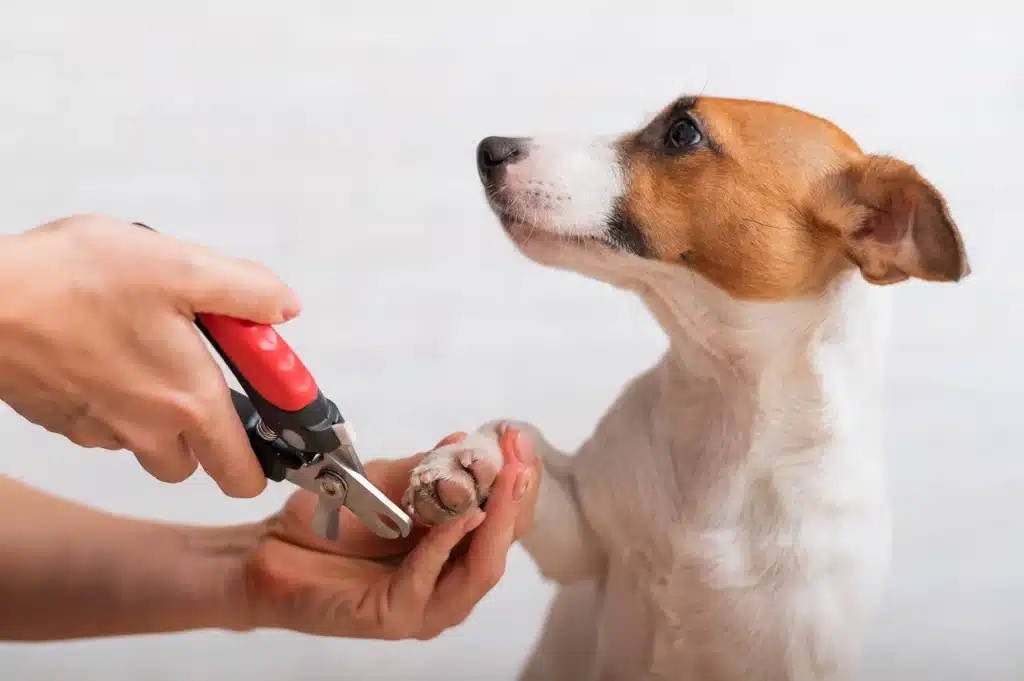
Current Essentials pricing lists 15 minutes of deshedding at about $20, 30 minutes at about $40, gland expression at about $25, a paw-dicure at about $50, and special handling at about $25.
Most dogs need none of these. They are not line items you should mentally add to every haircut — they exist for the dogs who genuinely need them.
What to budget
If you simply want a figure for the month, start with your dog’s weight:
- 0–15 lbs — about $153
- 16–25 lbs — about $165
- 25–40 lbs — about $178
- 41–60 lbs — about $190
- 61–70 lbs — about $203
- 71–80 lbs — about $215
For dogs over 80 pounds, the Essentials haircut price continues to rise by weight category, reaching approximately $227 for 81–90 pounds, $240 for 91–100 pounds, $252 for 101–110 pounds, $264 for 111–120 pounds, $277 for 120–130 pounds and $289 for 131–140 pounds.
These are rounded estimates based on current Essentials pricing, not guaranteed quotes. Coat condition and any additional services needed on the day can affect the final cost.
What actually decides your dog’s haircut price
Strip away everything else and a dog haircut is priced on four things, in this order.
Size, because a bigger dog is more coat to wash, more coat to dry and more surface to trim — that is the $153 to $289 spread in the table, and it is the only part you can look up in advance.
Coat type, because a smooth 25-pound terrier and a curly 25-pound doodle sit on the same line of that table and are not the same afternoon. Continuously growing coats need preparation that shedding coats do not.
Coat condition on the day, because a maintained coat is a haircut and a compressed one is a recovery. This is the only variable you fully control, and it is the one that moves the number most.
The service itself, because a clipped body, a scissored finish and a full deshed are different pieces of work wearing the same word.
That order is worth remembering, because it tells you where your effort is best spent. You cannot change your dog’s size or coat type. You can change the condition it arrives in, and doing so keeps you on the price you looked up rather than a different one.
In North Texas that means accounting for a climate that is harder on a coat than most: a spring pollen season that binds loose hair, summers that push single-coated dogs to shorter lengths and double-coated dogs to deshedding rather than clipping, sandburs in autumn, and enough mild weather that dogs here are outdoors collecting all of it year-round.
A dog who arrives on schedule with a combed-through coat gets the price on the table. That is the whole trick, and there is not much more to it than a steel comb and a calendar. If you would like a figure worked out for your own dog before you commit to a schedule, send us the details — weight, breed or mix, coat length and honest condition — and we will come back with something you can plan around.
Frequently asked questions
Is the bath included in the haircut price?
Yes. The Essentials haircut price includes washing, rinsing, drying and brushing out before the cut.
Do you price by breed or by weight?
By weight, with coat condition considered on top. Breed tells us what kind of coat to expect; weight sets the starting category.
Should I shave my dog for the Texas summer?
Only if they are single-coated. Double-coated breeds should be deshedded, not clipped — the coat protects them from heat and sun as well as cold, and shaving it can permanently change how it regrows.
What if I don’t know what haircut to ask for?
That is completely normal, and you do not need to know the terminology before you call. Describe how you want your dog to look and how much brushing you realistically want to do at home, and we will work out the rest.
Disclaimer: All prices listed in this article are provided for general informational purposes only and reflect pricing available at the time of publication. Pricing varies by location, as Kontota locations are independently owned and operated. All prices, services, packages, promotions, discounts, fees, and availability are subject to change at any time without prior notice and may vary based on your dog’s breed, size, weight, coat type, coat condition, temperament, grooming requirements, and service location. Additional charges, including applicable taxes, travel fees, fuel surcharges, and optional services, may apply. Published prices and online estimates are not guaranteed quotes or binding offers. Final pricing will be confirmed by your servicing Kontota location based on the services requested and your dog’s individual grooming needs. Please contact your local Kontota location or use our online pricing estimator for the most current pricing information.
