


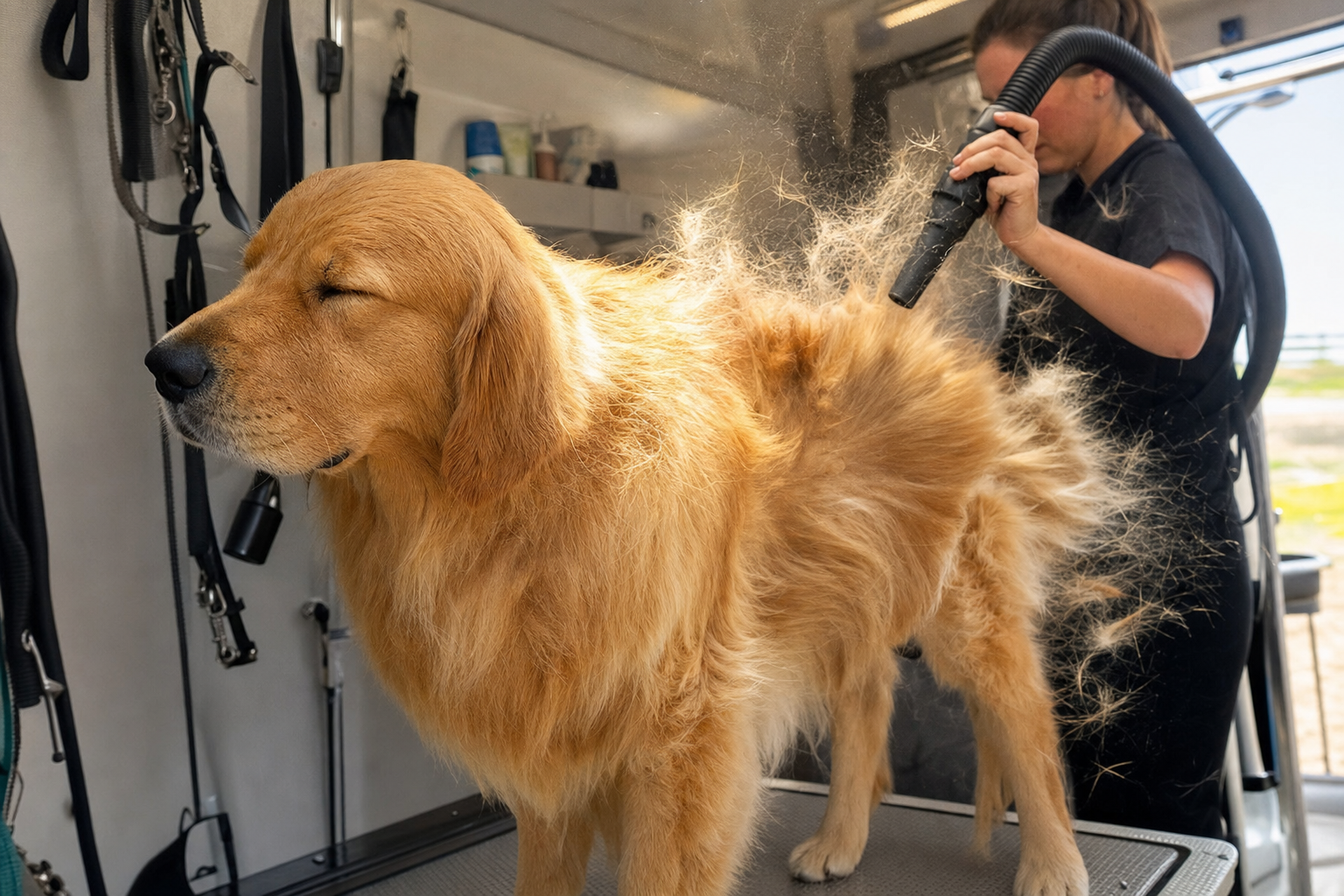
Marigold came to me in July. Golden retriever mix, three years old, owned by a couple in Plano who said they vacuumed twice a day and still found fur in their coffee. The undercoat was packed so tight it hadn’t moved in months. One blow-out session later, we pulled enough loose fur to stuff a throw pillow. That’s a normal Tuesday in Dallas summer, honestly.
Quick answer: Dallas dogs shed hard from late spring through August. A proper deshedding treatment removes loose undercoat that a home brush can’t reach. It cuts visible shedding by 60 to 80 percent for several weeks and prevents the packed, damp undercoat that causes hot spots and skin irritation. Most double-coated breeds need professional deshedding 2 to 4 times a year.
Why Dallas Dogs Shed So Much in Summer
Dallas hits 100 degrees Fahrenheit for weeks straight. Dogs don’t sweat through their skin. They regulate heat through panting, and their coat acts as insulation in both directions. Double-coated breeds like golden retrievers, huskies, and German shepherds grow a dense undercoat in winter, then try to dump it all starting in late spring. The problem is that undercoat doesn’t just fall out cleanly. It packs against the skin, traps heat, and forms a tight mat layer the outer coat hides. Most owners don’t notice until bath time, when the whole thing becomes a wet, compressed mess that won’t dry for hours. Here’s what catches people off guard: a packed undercoat makes your dog hotter in July, not cooler. Air can’t circulate near the skin. And warm, damp skin is exactly where hot spots and skin infections start.
What Deshedding Actually Does
A bath alone won’t fix a packed undercoat. Water loosens surface dirt, but compressed undercoat just soaks it up and sits there. Real deshedding starts dry. A high-velocity dryer runs through the coat before the bath to blow out loose undercoat while it’s still fluffy and separate from the topcoat. Then comes a deshedding shampoo with conditioner, which opens the follicle and helps the remaining undercoat release. After the bath, the dryer again, then a slicker brush and sometimes a dematting rake on the dense spots. Done right, you’re pulling out what was going to shed over the next six to eight weeks, all in one session. The result is a lighter, airier coat and noticeably less fur on your furniture. A mobile deshedding visit typically runs about 90 minutes for a medium-sized dog, longer for larger breeds like a great pyrenees.
The Tools That Make the Difference
Using the wrong brush on a double coat either misses the undercoat entirely or damages the topcoat. Here’s what a proper deshedding session actually uses:
| Tool | What It Does | Best For |
|---|---|---|
| High-velocity dryer | Blows out loose undercoat before and after the bath | Every double-coated breed |
| Slicker brush | Removes surface tangles and light undercoat | Goldens, doodles, border collies |
| Dematting rake | Breaks up packed undercoat mats | Huskies, malamutes, great pyrenees |
| Furminator-style tool | Dense undercoat removal near the skin | Labs, German shepherds, corgis |
| Deshedding shampoo and conditioner | Opens follicles and releases loose fur | Any breed actively shedding |
How Mobile Deshedding Works Differently
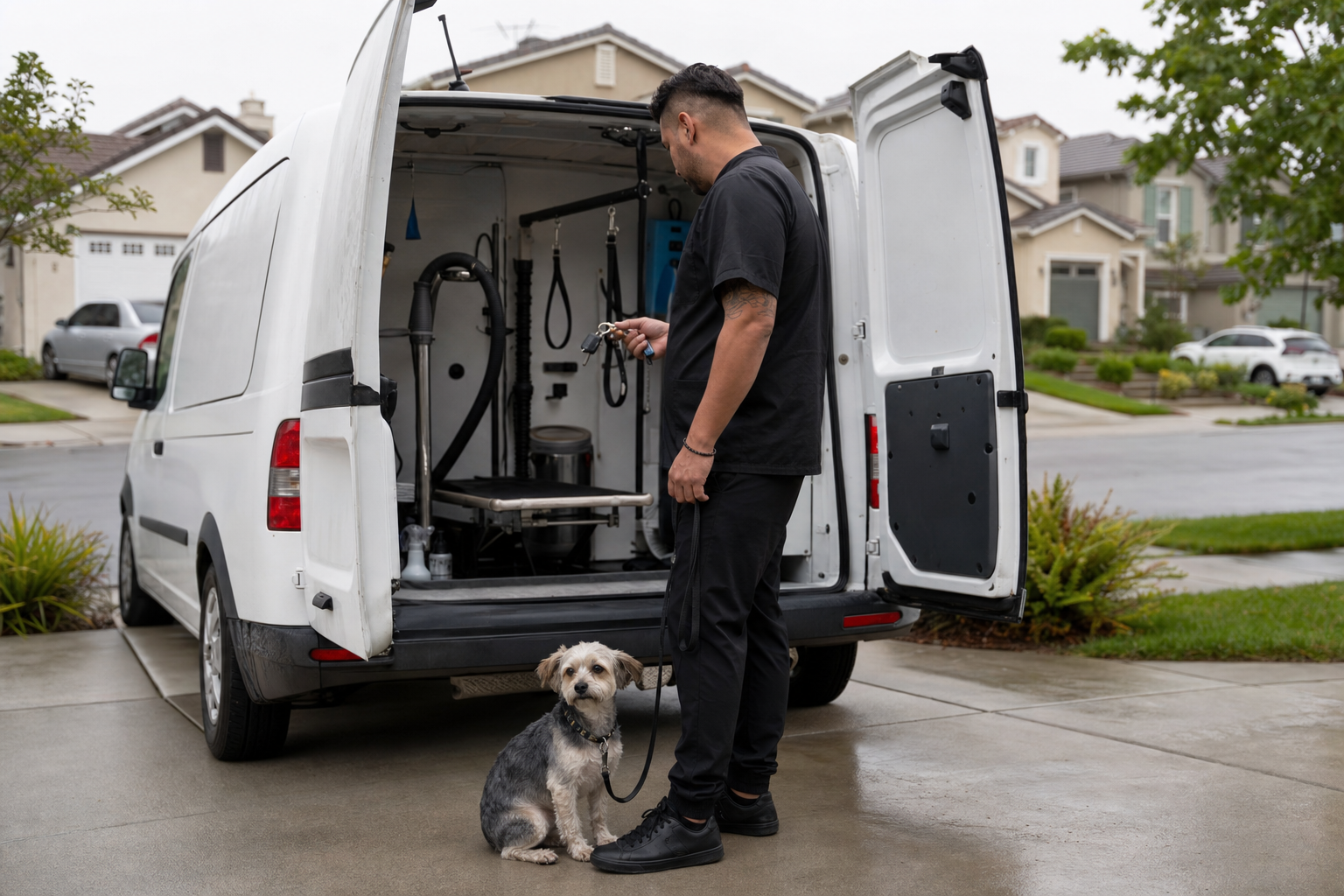
Salon deshedding means dropping your dog off and waiting. Four, sometimes five hours. By the time a groomer gets to them, the dog has been in a crate surrounded by other dogs and unfamiliar sounds. A stressed dog is harder to work on, takes longer to settle, and the session suffers for it. Mobile grooming skips all of that. Your dog walks from your front door into the van, gets a one-on-one session with no other dogs around, and comes back to you in about 90 minutes. For high-anxiety dogs, the difference shows up immediately. Mobile grooming DFW routes cover most of the metroplex, including Plano, Frisco, Allen, Irving, and Arlington. Worth checking current availability in your zip code before booking.
Which Dogs Benefit Most?
Any double-coated dog benefits, but some breeds pack undercoat faster than others. Huskies, malamutes, and great pyrenees are the obvious cases. Their coats are built for Arctic winters and they don’t naturally adapt to Texas summers, so undercoat builds up fast. Golden retrievers and labs shed more evenly year-round, but they still pack undercoat hard during their spring and fall blows. German shepherds and Belgian malinois shed continuously at a moderate rate and benefit from a professional blow-out every six to eight weeks. Mixed breeds with double coats vary. If you’re unsure whether your dog has a double coat, press two fingers into the fur at the base. If you hit a second, softer layer before reaching skin, that’s your answer.
How Often Does Your Dog Really Need It?
It depends on breed and how your dog lives. A husky that stays in AC year-round sheds differently than one outside most of the day. Here’s a rough schedule for DFW owners:
| Breed Type | Shedding Pattern | Suggested Frequency |
|---|---|---|
| Siberian Husky, Alaskan Malamute | Heavy twice-yearly blow-out | Every 8 to 12 weeks in summer, 12 to 16 in winter |
| Golden Retriever, Labrador | Moderate year-round, heavy spring and fall | Every 8 to 12 weeks |
| German Shepherd, Belgian Malinois | Year-round moderate to heavy | Every 6 to 10 weeks |
| Border Collie, Australian Shepherd | Seasonal moderate pack | Every 10 to 14 weeks |
| Corgi (Pembroke or Cardigan) | Heavy undercoat year-round | Every 8 weeks in summer |
- You’re finding fur clumps in corners your vacuum missed
- Your dog scratches more than usual but has no fleas or visible skin issue
- The coat feels unusually thick when you press a hand in
- Bath time leaves a wet, matted mess that takes hours to dry
- It’s been more than three months since the last professional groom
What to Expect After the Appointment
You’ll probably still see a little loose fur in the first 48 hours. That’s normal. Deshedding loosens fur from the follicle and not every strand releases at once. After two days, run your hand through the coat and you’ll feel the difference: less resistance, lighter coat, clean skin at the base. Most owners say their house stays noticeably cleaner for four to six weeks after a proper deshedding session. The first time is usually the most dramatic, especially if it’s been six months or more since the last real groom. The dog is more comfortable too. That part surprises people. A packed undercoat traps heat the dog can feel, even if you can’t see it from the outside. A blown-out coat actually lets air move the way it’s supposed to.
If you’re in DFW and want to see everything a Kontota visit includes, the mobile dog grooming services page has a full breakdown. You can book directly from there.
Marigold’s owners rescheduled before I even pulled out of the driveway. Their coffee is fur-free now. Mostly.
