


An Austin mobile groomer’s six-phase technical playbook for brushing out a matted coat without going to the clipper, plus when honest groomers refuse.
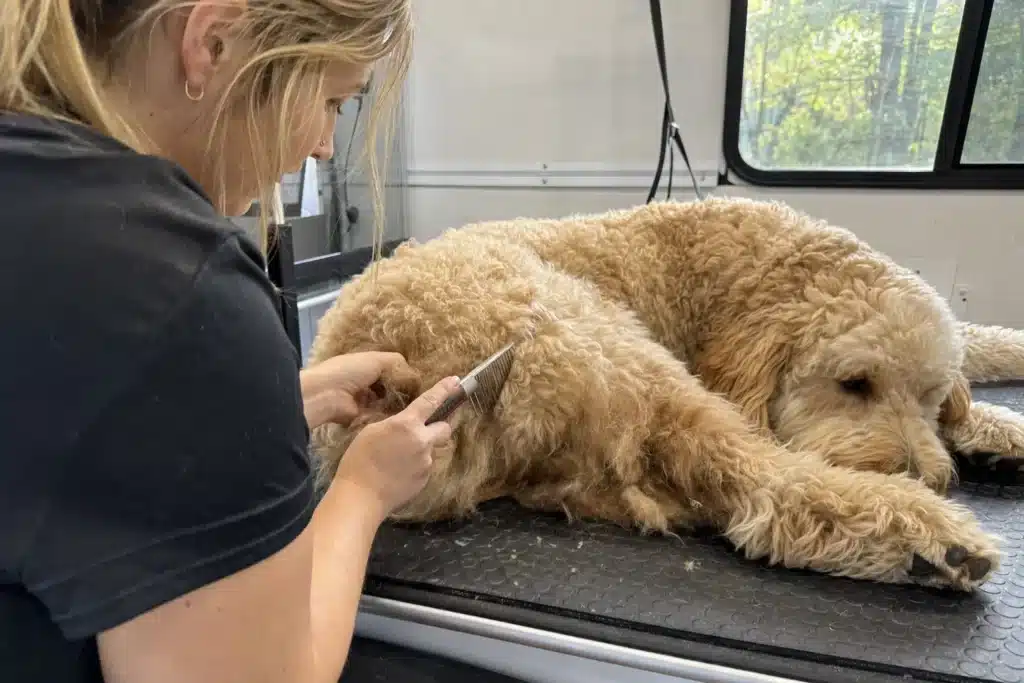
I’ve been mobile-grooming dogs in Austin for nine years. The single most common booking we get is the panicked text that reads, ‘I think I waited too long, please just shave him.’ Eight times out of ten, we don’t have to. Here’s the actual technical sequence I use to brush out a matted coat without going to the clipper, when it’s safe to do, and when honest groomers refuse.
Quick answer: a coat with mats up to 3 mm thick that don’t pull skin can almost always be brushed out, in a 35 to 60 minute session, with a high-velocity dryer, a dematter rake, and slip-coat conditioner. Mats that pull skin or hide hot spots get the clipper, every time.
Read the Mat Before You Touch a Brush
Walk fingers under the mat. Lift gently. If you can see daylight between mat and skin, you have working room. If the mat sits flat against the skin and the skin moves with the mat, stop. Same answer if the dog flinches when you lift. That mat is fused to the coat root and probably trapping moisture, which means a hot spot or a yeast pocket underneath. We cut, we don’t brush.
The other test is the toothpick test. Push a wooden toothpick through the mat to skin. Easy in? Workable. Toothpick bends? You’re brushing dead hair fused into a felt sheet. That goes to the clipper too. Mobile groomers in Austin see a lot of these in late summer, especially on doodles whose owners ‘kept up with the brushing’ but only on the topcoat.
The Tools That Earn Their Spot in the Van
Most owners think a matted coat needs the right brush. It needs four tools, in a specific order, plus a working air supply.
- High-velocity dryer at 18 to 24 amps. The dryer is the actual de-matter, not the brush. Air, not bristles, separates undercoat from topcoat.
- Slicker brush, oval head, medium pin density. Stainless pins, not gold-coated. The cheap ones bend after a year.
- Dematter rake with five to seven curved blades. Used surgically, not as a comb.
- Greyhound comb, fine-medium combination. The comb is the test instrument, not a working tool.
- Slip-coat conditioner spray, lanolin-based. Pet-safe. Avoid silicone-only formulas, they coat the mat instead of penetrating it.
Most retail grooming kits have the slicker and the comb but skip the dryer. Without the dryer, you’re working three times as hard for half the result. If you brush out at home regularly, a real variable-speed dryer is the one upgrade actually worth owning.
The Six-Phase Brush-Out, Step by Step
Inside the van, with the dog calm and the dryer warmed up, the sequence runs like this.
| Phase | Tool | What you’re actually doing | Time on a medium doodle |
|---|---|---|---|
| 1. Pre-soak | Slip-coat spray, fingers | Saturate every mat. Let it sit 4 minutes. Conditioner does most of the work. | 5 min + soak |
| 2. Air-blast | High-velocity dryer | Skin-out, not topcoat-down. Push air against the lay of the coat to lift the undercoat free. | 10-15 min |
| 3. Slicker pass | Slicker brush | Top half of the mat first, then the bottom half. Hold skin with your other hand. | 8-12 min |
| 4. Rake on the stubborn ones | Dematter rake | One blade at a time, not a swipe. Each blade lifts a 2 mm seam of coat. | 5-10 min |
| 5. Comb-through | Greyhound comb | If it doesn’t pass clean from skin to tip, you’re not done. | 3-5 min |
| 6. Re-bath and full dry | Bath, then dryer again | Clean the loosened debris out, then dry to skin to lock in the de-mat. | 20 min |
End-to-end brush-out sequence. Total session is 35 to 60 minutes for medium dogs, 60 to 90 for large doodles or aussies.
Where Owners Get It Wrong at Home
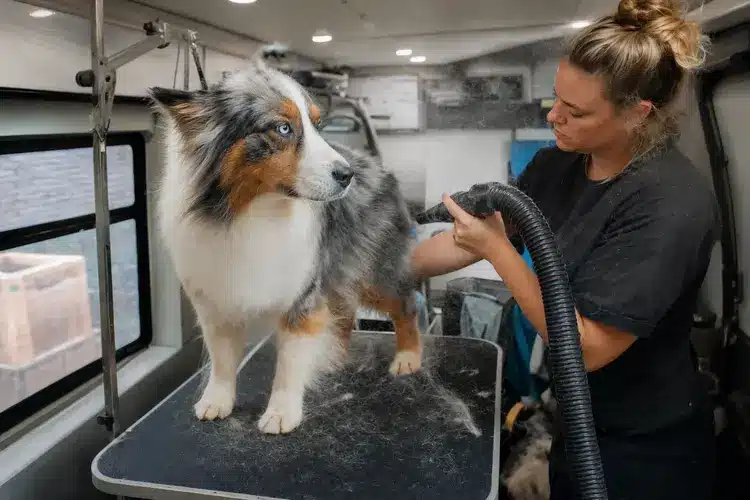
The most common mistake is brushing dry. People grab the slicker and start pulling. That hurts. The dog learns brushing is a punishment. By visit two, the dog hides under the bed when it sees the kit. Conditioner-spray every mat first, every time. Wait the four minutes. The mat will let go on its own about a third of the way.
Second mistake: brushing the topcoat only, calling it good, and not noticing the undercoat is felting underneath. Run a comb to skin every week. If the comb stops, you have early matting and ten minutes of brushing fixes it. Wait three weeks and you’re booking a mobile groomer.
Third mistake: the wrong order. Bath first, brush second. That locks mats tighter (water swells the felted hair). Always brush first, bath second, dry to skin. We do this in that order in the van for a reason.
When We Refuse to Brush and Go to the Clipper Instead
Honest groomers have a line, and it’s not negotiable. We clip when the mat is pulling skin. We clip when there’s a hot spot underneath. We clip when the dog has been brushed-on for more than 90 minutes total without progress. The line exists because brushing past these limits actually hurts, and a dog who’s been hurt at the curb won’t get back in the van next time. The relationship is more important than the cut.
If you’re new to mobile and haven’t seen the inside of a van during a real appointment, the walk-through of a Dallas mobile grooming visit covers what the table, the lift, and the calming setup actually look like. Same general flow plays out at every Austin curb.
Frequency: How Often a Real Brush-Out Has to Happen
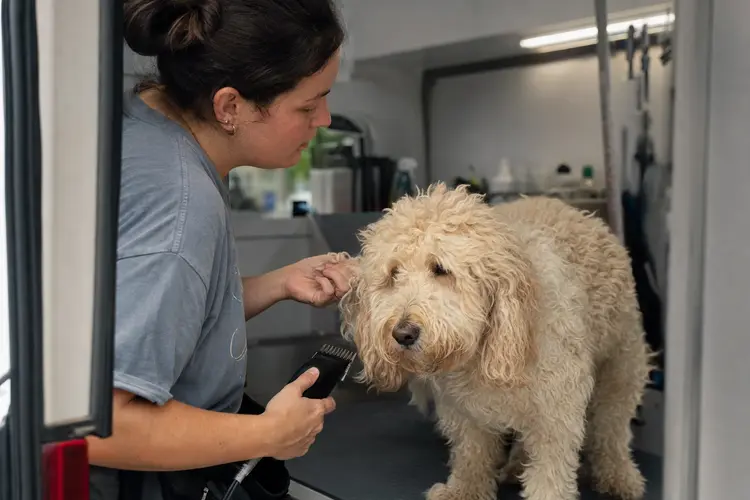
By breed, the realistic at-home brushing schedule looks like this. Doodles, every 48 to 72 hours, ten minutes minimum. Aussies and double-coated breeds, twice a week, with the dryer on undercoat-blowout day. Maltese and shih tzu, daily, two minutes. Smooth coats like beagles and pit mixes, weekly, with a rubber curry. If you can’t hit those numbers, build them into a recurring mobile slot.
Most Austin owners I see settle on a six-week mobile rotation with one or two at-home brush sessions in between. That’s a workable middle. The owners who try to stretch to ten weeks always end up needing a full de-mat reset, which takes the groomer twice as long and is harder on the dog. Run the math at your house and pick the rhythm your coat and your dog can actually live with.
Booking the De-Mat Session Specifically
For local service details and booking options, see Kontota’s mobile dog grooming in Austin page.
When you book Austin mobile, tell us at booking that the dog is matted, and send a phone photo. We allocate a longer window for de-mat sessions, around 75 to 90 minutes, and we charge per quarter hour beyond the base. The longer block lets us take real breaks for the dog (a 10-minute breather every 20 minutes is standard for stressed dogs) and gives us time to clean the van between phases.
If the photo shows pelt-style matting (one solid felt mat across the back), we’ll usually plan the clipper protocol by default and explain why on the phone, so nothing is a surprise at the curb. The Texas service area map confirms whether your zip is on a Tuesday or Friday route. Most matted Austin dogs go back to a normal six-week rhythm after one full reset session, and we don’t see them in the de-mat chair again.
